Build vs. Buy Software: A Decision Framework That Holds Up
Use this build-vs.-buy software framework to compare fit, control, integration, risk, ownership, and speed before committing your business.
By Mark Wellington · July 21, 2026 · 6 min read

The short answer
Buy software when the process is common, the product fits without major contortions, and the vendor's operating model gives you enough control. Build when the workflow creates a real advantage, existing products force costly compromises, or ownership of the experience and integration matters strategically. The right answer is often hybrid: buy commodity capabilities and build the layer that makes your business different.
What to take away
- →The sticker price is only one part of the decision; include adaptation, integration, ownership, migration, and ongoing operation.
- →Buy commodity capability and protect custom development for the workflows that create real differentiation.
- →A heavily customized subscription can carry custom-software complexity without giving you custom-software control.
- →Score the decision against the next three years of operating reality, not the best-looking week of the sales demo.
The build-versus-buy conversation usually starts in the wrong place.
Someone finds software that costs less than a custom build. Someone else lists twelve things it cannot do. A third person says, “Couldn’t we just connect it to Zapier?” Soon the room is comparing a polished monthly price with a vague development estimate while quietly ignoring the next three years of operational consequences.
Here is the useful answer: buy the capabilities that are ordinary and well served; build the capability that makes your operation meaningfully different. When the line is blurry, use fit, control, integration, risk, ownership, and speed to find it.
Cheap software gets expensive when the business has to bend around it
Off-the-shelf software wins for good reasons. It already exists. It has users, support, updates, and a list of features long enough to make procurement feel productive.
If your need is common—accounting, payroll, email, calendars, standard customer records—you usually do not earn a medal for rebuilding it.
The trouble starts when “configuration” becomes a company-wide coping mechanism. Employees create side spreadsheets. Data is exported and re-entered. The sales process changes to satisfy the CRM. A critical handoff lives in one employee’s memory because the product cannot represent it.
At that point, you are paying for the software and for the workarounds.
Custom software gets expensive when every preference becomes a requirement
Building is not automatically the brave strategic choice. Sometimes it is a very elaborate way to avoid changing a bad process.
Custom software brings control, but control arrives with responsibility. Someone must make product decisions, protect data, handle access, test changes, monitor failures, maintain integrations, and keep the system useful as the business evolves.
That does not make custom development a bad investment. It means the advantage has to justify the ownership.
Use the six-part Control Gap Test
Score each dimension from one to five. A low score favors buying. A high score suggests the gap between available products and your operating needs may justify a custom layer.
1. Fit: how much of the real workflow works naturally?
Ignore the feature checklist for a moment. Walk through three real scenarios—including one ugly exception.
How many steps work as intended? Where do people leave the system? Which required details have nowhere sensible to live? How much training is actually instruction for working around the product?
A product that matches 90 percent of a feature list can still miss the 10 percent where your business makes money.
2. Advantage: does this workflow make you different?
If customers do not notice the workflow and competitors perform it roughly the same way, buying is attractive.
If the workflow shapes the customer experience, compresses a meaningful delay, protects unique know-how, or lets your team deliver in a way generic tools cannot, building becomes more interesting.
Do not custom-build commodity work because it feels important internally. Save custom effort for genuine leverage.
3. Integration: will the product join the operation or become another island?
Ask where data enters, where it must go next, how identities and permissions work, and what happens when an integration fails.
An API logo on a pricing page is not an integration plan. Confirm that the required data and actions are actually available, within acceptable limits, under terms you can live with.
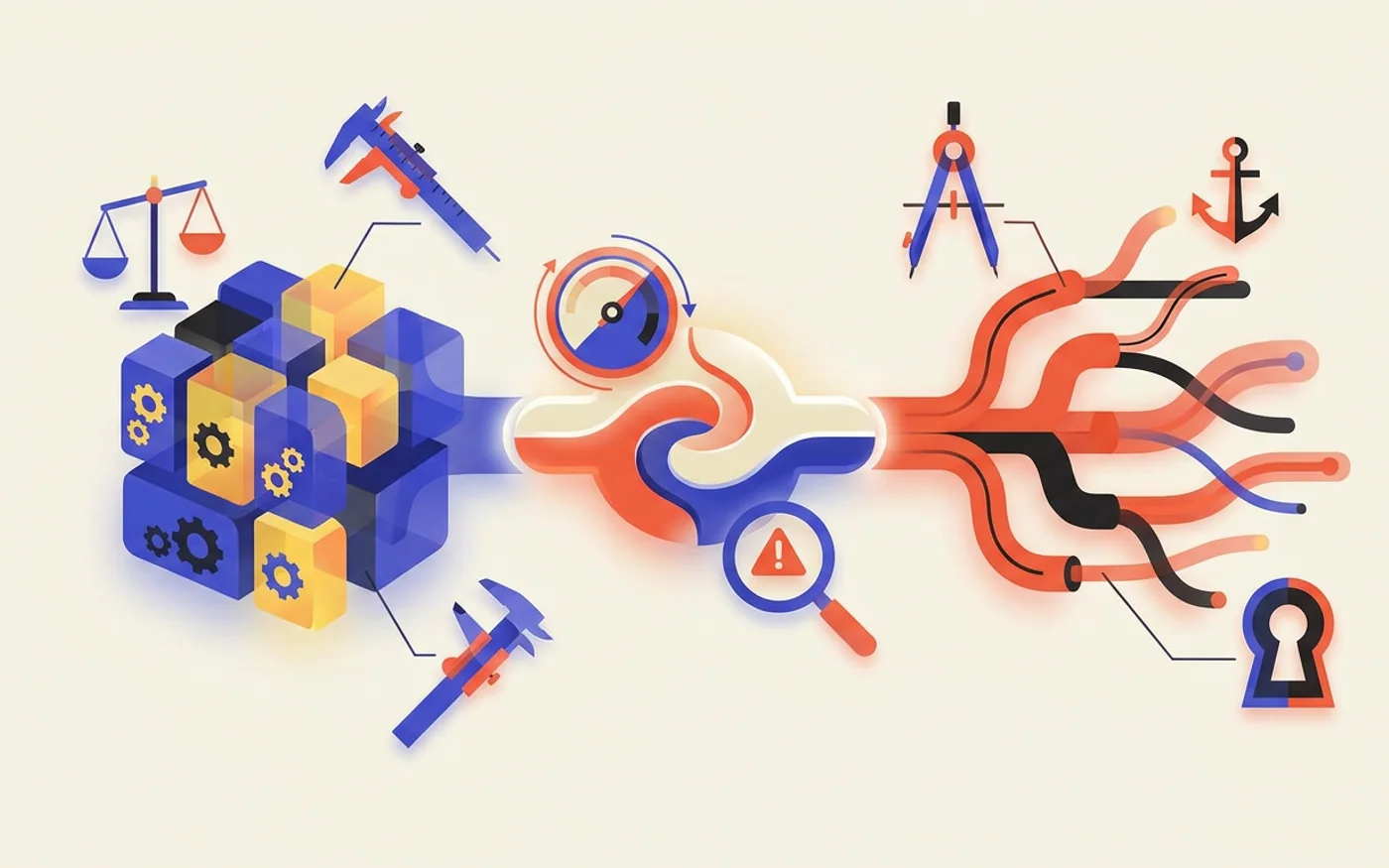
4. Risk: which choice creates the failure you can live with?
Buying creates vendor risk: product changes, pricing changes, service interruptions, weak export options, support limits, and security decisions you do not control.
Building creates delivery and operating risk: unclear scope, weak adoption, maintenance gaps, security mistakes, and dependence on a system only one person understands.
Good procurement makes vendor risk visible. CISA’s software acquisition guidance and supplier-response tooling encourages buyers to examine supplier and software-assurance risk instead of treating a purchase as the end of due diligence.
The winning option is not risk-free. It has the risks you can understand, own, and reduce.
5. Ownership: what must you control five decisions from now?
Think beyond source code.
Do you need control over the roadmap, customer experience, data model, integrations, deployment timing, or ability to move to another provider? Can you export your data in a useful shape? Can the vendor remove a capability your operation depends on?
With custom software, ownership language and handoff quality matter. With purchased software, portability and contract terms matter. In both cases, “we have access” is not the same as “we have control.”
6. Speed: which option reaches credible learning sooner?
Buying usually wins the first-login race. It does not always win the useful-operation race.
Include configuration, migration, integration, approval, training, and workflow change. For a build, include discovery and a deliberately narrow first release—not the entire dream backlog.
The fastest option is the one that gets a real user through the real job with the fewest hidden dependencies.
Do not compare a subscription price with a project quote
Compare operating choices.
For a purchase, consider:
- subscription and usage charges;
- implementation and migration;
- required companion tools;
- integration and workaround labor;
- training, support, and switching cost.
For a build, consider:
- discovery, design, and development;
- hosting, monitoring, and support;
- security, testing, and updates;
- future product decisions and enhancements;
- documentation and continuity.
NIST’s Secure Software Development Framework makes a point buyers and builders both need to hear: security practices must be part of the software lifecycle. Whether those responsibilities sit with your vendor, your development partner, or your internal team, they do not disappear because the interface looks finished.
The best answer is often a well-drawn seam
Hybrid does not mean “buy everything and connect it with hope.” It means choosing the boundary deliberately.
You might buy authentication, payments, email delivery, and a standard CRM while building the quoting workflow that captures your unique operating logic. You might buy a strong platform and add one custom portal that gives customers the experience the platform cannot.
The seam should be stable and observable. Each side needs a clear responsibility. Data should have an owner. Failures should be visible. The custom layer should protect your advantage, not reproduce features the market already solved well.
Spend a little effort before you spend a lot of money
The UK Government’s guidance on digital discovery begins with understanding the problem, users, constraints, and whether moving forward is worthwhile. That is equally sensible for a private business deciding between a vendor and a build.
Before choosing, map the workflow, open the vendor documentation, test real scenarios, inspect export and integration boundaries, and write down what you truly need to control.
If the Control Gap is small, buy confidently. If the gap sits directly on your competitive advantage, a custom software development conversation can turn that gap into a focused product plan. And if the answer is hybrid, make the seam a design decision—not an accident discovered after launch.
References
- [S01] CISA Unveils Tool to Boost Procurement of Software Supply Chain Security — Cybersecurity and Infrastructure Security Agency, August 26, 2025. Accessed 2026-07-21.
- [S02] Secure Software Development Framework (SSDF) Version 1.1 — National Institute of Standards and Technology, February 2022. Accessed 2026-07-21.
- [S03] How the Discovery Phase Works — UK Government Digital Service, Updated June 21, 2021. Accessed 2026-07-21.